Friday, October 29, 2010

FOUR COMPASSIONATE REFLECTIONS

There are 12 Reflections given in Jainism to meditate and there are also four compassionate Reflections or Bhavanas some times known as auxiliary Bhävanäs. They represent the positive means of supporting the Five Vows. They are intended to develop purity of thought and sincerity in the practice of religion. They play a very important role in the day - to - day life of a householder and these reflections can be practiced very easily. Adopting these Bhävanäs in daily life can make a person very virtuous.

These four Bhävanäs (reflections) represent the positive means of supporting the Five Great Vows.
The qualities, which a devotee of nonviolence must possess, are:

• Maitri (amity, love, friendship): Friendliness strengthens each other; friendliness softens the heart and nourishes the capacity for forgiveness and forbearance
• Pramod (joy and respect): Praising the virtues of others with joy and respect corrodes one’s own ego and conceit.
• Karunä (compassion): Compassion for their misfortune fosters a charitable heart
• Mädhyastha (neutrality): The cultivation of neutrality and equanimity has the power to chastise vainglory in self and others.
These Bhävanäs are designed to make the devotee a good person, to serve as aids to spiritual progress, to produce detachment, and to lead the devotee from the realm of desire to the path of purification. They are intended to develop purity of thought and sincerity in the practice of religion.

01. Maitri Bhävanä (Universal Friendship)
The cultivation of friendliness without any selfishness towards all living beings is Maitri (Universal friendship). The devotee should show equal friendship to all living beings without any reservation due to gender, color, race, wealth, nationality, look, size, and so on. Bhagawän Mahävir said that we must be friends of all living beings. Feelings of friendship should be the foundation of all our future thinking. Thus, when we become friends with someone or for that matter with all living beings, how can we possibly think of harming, deceiving or quarreling with them? How can our actions be harsh towards anybody? We would never hurt our friends; on the contrary, we support them and protect them. That way we develop bonds with each other. Friendship teaches us to be tolerant, to forgive, and to care and share among one another. There will be times when our thoughts may be reactionary and harsh; at that time instead of reacting right away, it would be better to wait and think of friendship with the person concerned. This always serves to ease the reaction, making you more reluctant to do anything that is not desirable. Since human nature is such that it always happens to react, Bhagawän Mahävir said, “If you want to react, then react with Pramod (respect)”.

02. Pramod Bhävanä (Respect for Virtue)
Pramod (joy, praise, and respect), or delight in the virtues of others, is defined as a state of experience of real joy and enthusiasm for those who possess higher and superior qualities. In this Pramod Bhävanä, we admire the successes and virtues of our friends, and spiritual leaders. Whenever we come across virtuous people, we should really respect, honor, and admire their virtues. When we are overwhelmed with joy because of such fine virtues in our friend, and spiritual leaders, the process of becoming virtuous begins. Good virtues are the right faith, the right knowledge, the right conduct, and the right penance. We should praise and show our highest respect to Tirthankars who showed the path and Gurus who help us in following that path for our spiritual journey.

Human nature is such that sometimes it cannot tolerate even the successes of friends or virtuous people. Sometimes, we are so jealous that we label their good virtues as bad qualities. When we are burning in the fire of jealousy, it ignites the fires of cheating, lying, and hurting others. However, instead of being jealous of the success or higher virtues of our friends or our spiritual leaders, we should feel content that if not me at least my friends are doing well; that way our unhappiness will turn into happiness. In addition, as soon as such thoughts come in our mind, we may feel silly that we had become jealous. That way the friendship or feeling of admiration would turn the negative impulses into the positive ones and we would be more at peace.
When we consider everyone as our friend, hostility stops, and when we start admiring successes of our friends even a negative force like jealousy would disappear.

03. Karunä Bhävanä (Sense of Compassion)
There are two types of compassion, (1) material and (2) spiritual. When we see someone is homeless, poor, and sick, or in need of something, the feeling we get to help is called material compassion. By helping the needy materially, we are able to reduce their material suffering. At the same time, there are people who are ignorant, have wrong beliefs, are suffering from internal passions such as anger, ego, deceit and greed; the feeling to help them is spiritual compassion. We try to show them the right spiritual path to reduce their internal suffering.

04. Mädhyastha Bhävanä (Neutrality)
To have indifference or to stay neutral in an irretrievable situation is Mädhyastha Bhävanä. In Mädhyastha Bhävanä one should stay neutral, uninvolved with those who, even after realizing and knowing what is right and wrong, carry on wrong ways. We can try our best to help, support, or advice; but some, out of their arrogance, obstinacy, stubbornness, or ignorance, may refuse to walk the right path. Instead of developing hatred, anger, contempt, or abhorrence towards them, we should think that we have done all we can; and changing is up to them. We should not let our mind be disturbed by what they are doing. Even though we desire the well-being of such people, we do not get involved unless they come for help.

THE IMMORTAL SONG
FRIENDSHIP
May the sacred stream of amity flow forever in my heart

May the universe prosper, such is my cherished desire;

RESPECT
May my heart sing with ecstasy at the sight of the virtuous,

And may my life be an offering at their feet.

COMPASSION
May my heart bleed at the sight of the wretched,

And may tears of compassion flow from my eyes;

NEUTRALITY OR EQUIMINITY
May I always be there to show the path to the pathless wanderers of life,

Yet if they should not hearken to me, may I bide

May the spirit of goodwill enter into all our hearts,

May we all sing together the immortal song of brotherhood

The immortal song of sisterhood,

The immortal song of brotherhood

- Chitrabhanu

ALSO READ: 12 REFLECTIONS

Sunday, October 10, 2010

SIX FUNDAMENTAL TRUTHS RELATED WITH THE SOUL


Here are the six fundamental truths related with soul, preached by the Tirthankaras (The Enlightened Masters) and explained by Shrimad Rajchandra.

"Those enlightened, who have attained true knowledge of Self, have described the following six fundamentals as the supreme abode of right faith".

1. Soul Exists - First fundamental:
‘There is an existence of the soul’. As there is an existence of physical objects like pot, cloth, etc, so is the existence of soul. As the properties of pot, cloth, etc. are the evidence of their existence, so the obvious property of consciousness to manifest itself as well as others is the evidence of the existence of soul.

2. Soul is Eternal - Second fundamental:
‘The soul is eternal’. A pot or a cloth stays as such for some time; but the soul stays forever. The pot and cloth are composed of some materials, but the soul is a substance on its own because it is not possible to produce a soul. Consciousness cannot arise out of any composition, so it is not a product. Because the soul is not created, it is nonperishable. As what cannot be produced cannot merge into anything else.

3. Soul is the Doer of its Action - Third fundamental:
"The soul is the doer (Kartä)’. All objects are associated with purposeful activity. All of them are seen with some or the other process that causes alterations. The soul also is imbibed with activity. Having the actuation, it is doer. The omniscient Lords have described three types of such actuation. In the absolute state when the soul stays tuned to its pure nature, it is the doer of that nature; in normal practice (which can be experienced; which comes in close contact), it is the doer of material Karma; and nominally, it is the doer of physical objects like buildings, towns, etc.

4. Soul Bears Consequences of its Action - Fourth fundamental:
‘Soul bears consequences’. (Soul is Bhoktä) All activities are fruitful. It is the obvious experience that whatever is done has its consequences. Consumption of poison or sugar and contact with fire or snow do not fail to produce their respective consequences. Similarly, if the soul indulges in defiled or undefiled state, that state too is bound to be fruitful and it produces consequences.

Thus being doer soul is Bhoktä and it bears the consequences as well.

5. Soul Can Be Liberated - Fifth fundamental:
‘There is liberation’. Soul has been described above as being doer of material Karma and being subject to their consequences. Those Karma can, however, be terminated as well; because even if prevailing defilement etc. are very acute, they can be reduced by discontinuance of practice, by avoiding contact and by calming them down. They are reducible and can be destroyed. The state of bondage thus being destructible, the pure state of soul devoid of all bondage is the state of liberation.

6. Means to Achieve Liberation - Sixth fundamental:
‘There are means to achieve liberation’. If bondage of Karma simply continues to occur, its cessation can never be visualized. There are, however, factors like right faith, right knowledge, right conduct, conviction, staying tuned to soul, detachment, devotion etc. that are manifestly opposites of the bondage of Karma. By the intensity of these means, the bondage gets loose, gets pacified and can be destroyed. Therefore, knowledge, faith, restraint etc. are the means for attaining liberation.

These six fundamentals, which are termed by the blessed enlightened as the supreme abode of right faith, have been narrated here in brief. The soul that is closer to liberation would easily find them accurate and entirely convincing. Consideration of these aspects in all perspectives would lead to the rise of discernment within. The supreme entity has pronounced these six fundamentals as beyond all doubts. Discernment arising from these six aspects can be helpful to the soul in comprehending its true Self.

The enlightened entities have laid down the teaching of these six aspects for removing the sense of ego and attachment of the worldly soul that arises from its dreaming state, which has been prevailing since time without beginning. If the soul realizes that its true nature is beyond that state, it would easily gain awareness and obtain right faith. By gaining right faith, it would attain liberation in the sense of realizing its true Self. The sense of exultation, grief or other interaction would not occur to it from any perishable, impure or such other impact. That awareness would lead it to experience, from close proximity, its own natural purity, perfection, imperishability and boundless joy.

It has been accustomed to identity itself with unnatural states. It would now gain a clear, visible, vivid, manifest experience of being completely distinct from such states. The interaction with the perishable or such other objects would not be viewed by it with the sense of desirability or undesirability. It would feel gratified with the knowledge and experience of its own true Self as being the abode of perfect greatness, free from any affliction of birth, old age, death, disease etc.

All the people, who are convinced of the soul, by the appropriate description of these six fundamentals by the supreme entities, have realized their true state. In the past, such people have gotten free from worries, disease, afflictions and all other interactions; presently such people do get free and the same will happen in the future.

Let our highly devoted obeisance be to the enlightened entities who have laid down the path to abide at ease within the true self that can forever end the affliction of birth, old age and death.

The true nature of the soul can arise by daily and continuous adoration of their innate compassion. Lotus like feet of such enlightened may always stay within our hearts.
It is not possible to define the attributes of the enlightened, the adoption of whose instructions easily leads to the manifestation of true Self as evidenced by these six fundamentals. By such manifestation, the soul gains fearlessness that arises from the attainment of everlasting bliss.

By their innate compassion, the enlightened entities have conferred the supreme disposition without desiring any thing whatsoever and yet have never conceived that so and so is my pupil or is mine because he is my devotee. Repeated obeisance with intense devotion is to such enlightened entities.

Such entities have laid down devotion for the true Guide solely for the benefit of Pupils. They have prescribed devotion so that the tendency of pupils may stay towards the state of the Guide’s soul, self-indulgence may come to an end by witnessing their unprecedented attributes and the true Self may be easily visualized. Our all time obeisance will be to that devotion and to those enlightened entities.

Omniscience has of course not been presently manifested. It has, however, been clearly known as a potentiality from the words of the enlightened entities. Omniscience exists as a matter of faith, as a state to be contemplated and a state to be aspired; and from the absolute point of view, it is prevalent within. Repeated obeisance with supreme devotion is to the benevolence of the enlightened entity, by whose grace this soul easily got worthy of attaining omniscience that manifests the unobstructed bliss.

article courtesy: Jain Philosophy & Practice

Saturday, September 25, 2010

COMPASSION LEADS TO EMANCIPATION

It is not true that only humans can develop compassion and love toward all living beings. Some animals also have capacity to develop such level of compassion toward other living beings. In the ancient Jain texts it is mentioned that how compassion plays major role for the progress of the soul toward liberation. There is a beautiful story in the history of an elephant in the history of Jainism which states that how compassion and kindness toward all living being plays major role in spiritual upliftment.

This is a story about an elephant. Once, there was a wild fire in the forest where that elephant used to live. All the animals came running and took refuge on the safe place. The elephant also went there. During that time, the elephant raised his foot to scratch his body because of an itch. That very time a rabbit was pushed in that space by the pressure of other animals. As the elephant tried to put the foot back, he felt the presence of the rabbit and decided to hold the foot up in order to save it. The fire raged for two and a half day during which the elephant continued to hold the foot up out of compassion for the rabbit.

At the end of fire as the animals retreated, the elephant tried to lower his foot. It had however stiffened during that time. The elephant could not maintain his balance and fell down. He felt agonizing pain and could not get up. That way he spent three days and night facing much affliction and acute pain. Ultimately the elephant left that body and were born as the prince, named Meghrath of King Shrenik, because of compassion for the rabbit.

At the age of 8 he was sent to school where he learned all 72 arts and crafts and became known as an accomplished youth. He was then married to 8 beautiful girls with whom he enjoyed all the pleasures of the worldly life. Once Lord Mahavira came to Rajgruhi and camped in Gunashil monastery. Almost every resident of Rajgruhi used to go to His sermon. Meghkumar went as well, and was very much impressed. Realizing the transitory nature of the worldly situations, as explained by the Lord, he decided to renounce his worldly life. But his parents were sad to hear about his intentions. They tried every means to stop him from renouncing. He however remained very firm. He left everything and became a possession-less monk of Lord Mahavira.

After becoming a monk in Lord Mahavira’s order, Meghkumar undertook fasting, meditation and other austerities in order to shed his karma. The Lord and his chief disciple Indrabhuti Gautam too praised him for that. When his body became very weak and could no longer observe the rigors of monk-hood, he decided to observe fast unto death. That he did for a month on mount Vaibhargiri near Rajgruhi and took birth in heaven. The Lord has stated to Indrabhuti Gautam that at the end of the heavenly life, he would be reborn in Maha-Videha part of the Universe and would attain salvation.

The story states how an elephant reached the level of higher purity of soul just because he had compassion for the rabbit in that birth.

Wednesday, September 8, 2010

PREVIOUS BIRTHS OF LORD MAHAVIR


It is said that a soul attains liberation after countable births after it attains samyak darshana (Right View). Jainism declares the hallmark of a person who has the right vision are, spiritual calmness (Prasanna), desire for liberation from the endless birth-life-death cycles (Samvega),without any attachment or aversion to anything (Nirveda), kindness (Anukampa), and belief in these fundamental principles (Astikya). After attaining Right View, the soul attains liberation after few births either by becoming a Tirthankar or by becoming ordinary Arihant.
If we glance in Lord Mahavir’s previous births then we would know that the soul of Lord Mahavir attained Right View in his birth as Nayasar. Before being born as Nayasar, the soul had transmigrated through infinite births but after attaining Right View in Nayasar’s birth the soul that became Lord Mahavir attained Liberation after 26 more births. So there were total 27 births along with Nayasar’s birth. Below is the list describing Lord Mahavir’s 27 births.

1. Nayasara – A village headman who secured samyaktva or partial enlightenment in this birth on account of preaching of true dharma by Jain monks
2. Birth in the 1st Celestial World (Heaven) called Saudharma
3. Prince Marichi – Grandson of Rsabha, the first Tirthankara and Son of King Bharata
4. Birth in the 5th Celestial World called Brahmloka
5. Kaushika – A Brahmin
6. Pushyamitra – A Brahmin
7. Bith in the 1st Celestial World called Saudharma
8. Agnidyota – A Brahmin
9. Birth in the 2nd Celestial World called Ishaan
10. Agnibhuti – A Brahmin
11. Birth in the 3rd Celestial World called Sanatkumar
12. Bharadwaja – A Brahmin
13. Birth in the 4th Celestial World called Mahendra
14. Sthavira – A Brahmin
15. Birth in the 5th Celestial World called Brahmloka
16. Prince Vishvabhuti
17. Birth in the 7th Celestial World called Mahashukra
18. Triprishtha Vasudeva – First Vasudeva of this half-time-cycle
19. Birth in the 7th Hell called Mahatamaha Prabha (pitch dark hued)
20. A lion
21. Bith in the 4th Hell called Panka Prabha (Mud Hued)
22. A human being (Name unknown)
23. Priyamitra – A Chakvartin (The universal ruler of seven continents)
24. Birth in the 7th Celestial World called Mahashukra
25. Prince Nandana – Accepted the vow of self control and gained Tirthankara nama karma
26. Birth in the 10th Celestial World called Pranat
27. Birth as Tirthankar Lord Mahavir, the final birth


Note: Between the births 5th as Kaushika Brahmin and 6th as Pushyamitra Brahmin, the soul transmigrated through countless births as insects, animals, plants, birds etc. Those births are not counted in Lord Mahavir’s 27 births. Again after the 21st birth as a hellish being in the fourth hell the soul had taken countless births as insects, animals, plants, birds etc and those births are not counted.

Monday, September 6, 2010

UVASAGAHARAM STOTRA


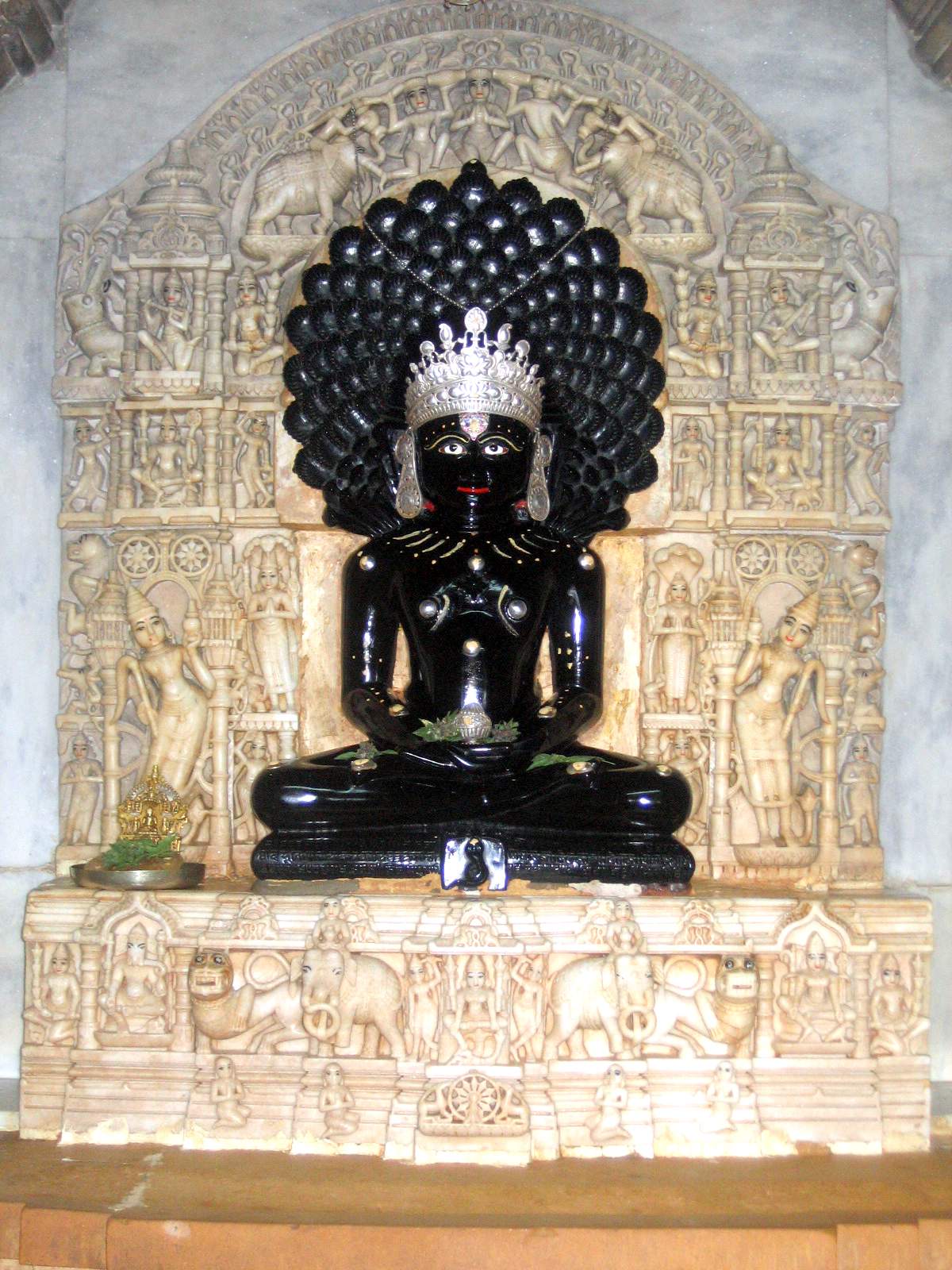
The Uvasagaharam Stotra is composed by Acharya Bhadrabahu (433-357 B.C.), is dedicated to Lord Parshva, the 23rd Tirthankar. Acharya Bhadrabahu had a brother named Varahmihir. Both were in the same kingdom. When a son was born to the king, Varahmihira declared that he would live for a hundred years but Bhadrabahu declared that he would live for only seven days, and that he would be killed by a cat. On the eighth day the prince died because of a door's anklet falling on his head which had a picture of cat drawn on it. Due to this humiliation Varahmihira left the kingdom and died after some time.
According to the story Varahmihira became evil and tortured and terrorized the Jains, especially disciples and followers of Bhadrabahu. Acharya Bhadrabahu then formed a mantric prayer to 23rd Jain Tirthankara Parshvanath called the Upsarga stotra (now known as Uvassagaharam Stotra) and called upon Dharnendra, the divine follower (a "devta") of Parshvanath. As an effect of it, Varahmihira was defeated and Jain society was relieved. That mantric prayer is still famous among the Jains and they chant it with due respect and faith. And that prayer had made Bhadrabahu's name immortal among Jain ascetics.


The Stotra is as below:

UVASAGGA-HARAM PASAM,
PASAM VANDAMI KAMMA-GHANA MUKKAM;
VISAHARA VISA NINNASAM,
MANGALA KALLANA AVASAM. (1)
VISAHARA PHULLINGA MANTAM.
KANTHE DHARE'I JO SAYA MANUO;
TASSA GAHA ROGA MARI,
DUTTHA JARA JANTI UVASAMAM. (2)
CHITTHAU DURE' MANTO,
TUJZHA PANAMO VI BAHUFALO HOI;
NARA-TIRIE'SU VI-JIVA,
PAVANTI NA DUKKHA DOGACHCHAM. (3)
TUHA SAMMATTE LADDHE',
CHINTAMANI KAPPAPAYA VABBHAHIIYE';
PAVANTI AVIGGHE'NAM
JIVA AYARAMARAM THANAM. (4)
IA SANTHUO MAHAYASA !
BHATTIBBHARA NIBBHARENA HIYAE'NA,
TA DE'VA ! DIJJA BOHIM,
BHAVE' BHAVE PASA ! JINACHANDA.

The meaning of the Stotra in English is as below:

I bow to Lord Parshwanath, who is served by the demi god. Parshwa, who is the remover of all afflictions, free from all sorts of Karmas, the destroyer ofthe poison of the poisonous animals, and is the abode of bliss and well-being.

If a man(manuo) who can recite this mantra by-hearted will get healed from all vish(poison) of life.All his problems will be solved by reciting this mantra daily

Aside from that charm, even bowing to you would be highly fruitful (resulting in divine life etc.); all beings would not (thereby) be in an unhappy or a miserable state.

If one gains the truth presented by you, which is superior even to thedesire yielding tree, the soul can gain age-less and immortal state withoutany obstacles. Great graceful Lord, I have adored you this way with devoted heart, therefore Lord Parshwanath, kindly bless me with the true knowledge in every(remaining) birth.

Friday, August 27, 2010

MEDITATION AND KAYOTSARG (abandonment of body)


Meditation (Dhyäna) is the process of concentration of the mind on a single topic preventing it from wandering. We are always every moment in meditation; either virtuous or non-virtuous. This concentration could arise from intense passions like attachment, aversion, hatred, animosity, etc. This is not virtuous meditation. Since non_virtuous meditation is a cause of rebirth, it is worthy of rejection. On the other hand, if it arises from the search for the truth and from absolute detachment towards worldly affairs, it is virtuous meditation.
According to Jainism there are four types of meditation:

  1. Sorrowful Meditation (Arta Dhyana)
  2. Wrathful Meditation (Raudra Dhyana)
  3. Righteous Meditation (Dharma Dhyana)
  4. Pure (spiritual) Meditation (Shukla Dhyana)

    If you observe the state of mind of the people, animal you will realize that most of them are always absorbed in the first two types of meditation (sorrowful and wrathful). Only few of them who are seeking liberation will be found in the righteous and pure meditation.

    1. SORROWFUL MEDITATION (ARTA DHYANA)

    The thought or activity caused by an outburst and intensity of sorrow is sorrowful meditation. In other words to desire for worldly pleasures, desire to get rid of sorrow or to get rid of disease is sorrowful meditation. The result of this type meditation is birth as animal, insect or plant.

    2. WRATHFUL MEDITATION (RAUDRA DHYANA)

    The meditation involving inclement thoughts is called inclement or wrathful meditation. In other words, one becomes happy by performing sinful acts like killing or desire to kill animal, insect, human etc is Wrathful Meditation. The result of this type of meditation is birth in hell.

    Summary of above two types of Dhyäna

    Sorrowful and wrathful meditations hinder spiritual uplift. They obscure the attributes of soul. They cause the natural disposition of self to disappear and initiate corrupt dispositions. Both these meditations are inauspicious and lead to an undesirable destination by accumulating more Karma. They are not related to spiritual advancement in any manner.

    3. RIGHTEOUS MEDITATION (DHARMA DHYANA)

    In this kind of meditation an aspirant meditates on teachings of Tirthankars, chanting mantra, meditates on the 12 Bhavanas (reflections) and asking for forgiveness for our bad deeds. Also the aspirant reflects on the 9 Tattva of the universe in this kind of meditation. The self should think that he/she is simply a light which has no foe or friend. Thereby he/she should leave all desire for beauty, age, strength, wealth etc.

    Types of Righteous Meditation:

    Doctrine oriented (Äjnä_vichaya) righteous meditation:

    It is contemplation about reality as described in the scriptures. Äjnä means whatever an all-knowing omniscient has said about religious truth is correct and true. One should not raise any doubts about them. Instead, one should think that it is possible that because of degrading time, the absence of an omniscient person, low caliber of my intellect, or any such reasons, I cannot comprehend the said religious truth but it is the truth. Omniscient Bhagawän has no reason to tell anything untrue. To think this way is called doctrine oriented righteous meditation (Äjnä Vichaya Dharma Dhyäna).

    Suffering oriented (Apäya_vichaya) righteous meditation:

    To think of the nature of unhappiness and misery as generated by defilements like attachment,, hate, strong desire for worldly pleasure and then to think about how to get rid of the defilements, is called universal suffering oriented righteous meditation (Apäya Vichaya Dharma Dhyäna).

    Karmic fruition oriented (Vipäk_vichaya) righteous meditation:

    To think that whatever pain or misery I suffer at every moment, wherever I move in the cycle of birth and death in worldly life, whatever ignorance I suffer are the results of my own deeds (Karma). I must practice equanimity during the fruition of different kinds of Karma so that new karma are not acquired. I must perform austerities to get rid of the existing Karma. This is karmic fruition oriented righteous meditation (Vipäk Vichaya Dharma Dhyäna).

    Universe oriented (Samsthäna_vichaya) righteous meditation:

    It is contemplation about the nature and structure of the universe. There are three world in the universe. They are the upper world, middle world (consist of billions of galaxies or dweeps) and lower world. These three worlds are filled with living (Jiva) and non_living (Ajiva) elements. The trans-migratory soul has gone through all these three worlds since beginningless time. As a result of the fruits of one’s own past deeds, the soul has been going through the infinite cycle of birth and death. This has happened due to ignorance, false beliefs, and not understanding the truth and reality. To think this way is called universe oriented righteous meditation (Samsthäna Vichaya Dharma Dhyäna).

    4. PUREST AND HIGHEST MEDITATION (SHUKLA DHYANA)

    The concentration achieved by an immaculate mind is the spiritual meditation. Spiritual meditation occurs to very highly progressed spiritual souls. It occurs at the 11th, 12th, 13th and 14th stages of spiritual progress (11, 12, 13, and 14 Gunasthänas). The highly spiritual soul has either suppressed or removed all deluding karma. This meditation is of four types as mentioned below. It consists of four states: Multi aspect (Pruthaktva_vitarka), single aspect (Ekatva_vitarka), subtle activity (Sukshma_kriyä Apratipäti) and absorption in self (Vyuparat_kriyä Anivritti). Vitarka means scriptural text or Sutra. A person who is in 11th and 12th Gunasthäna and is versed in the Purva texts performs the first two Shukla Dhyäna. There are exceptions possible like Mäsatusa and Marudevi, even though not versed in the Purva, can engage in Shukla Dhyäna. Only Kevali (13th or 14th Gunasthäna) can engage in the last two subtypes of Shukla Dhyäna.

    Types of Purest Meditation:

    Multi aspect spiritual meditation (Pruthaktva_vitarka)

    It is performed by an aspirant with scriptural knowledge. Here the aspirant is attempting to attain the spiritual stages of subsidence or destruction of the conduct deluding Karma. The aspirant concentrates upon the three modes - origination, cessations, and continuity- of a particular substance (one of Shad Dravya). This type of meditation involves shifting of attention between the meaning, word and activity of the aspects of the substance. Hence, it is called multi aspect meditation with shifting. This meditation suppresses or eliminates conduct - deluding Karma (Chäritra Mohaniya).

    Single aspect spiritual meditation (Ekatva_vitarka)

    It is contemplation on a single aspect of reality on the basis of scriptural knowledge by an aspirant who is in the delusion free (Kshina_moha) spiritual stage. The aspirant concentrates on one particular form, word, or activity of the aspect of a substance without shifting. Such meditation is the single aspect stage of spiritual meditation. Thismeditation eliminates the four destructive (Ghäti) karma, namely perception obscuring, knowledge obscuring, deluding and obstructing Karma. Thus, it leads to omniscience.

    Subtle activity spiritual meditation (Sukshma_kriyä Apratipäti)

    It is performed by an omniscient who has eliminated the gross activities of body, speech and mind, and has only subtle activities. Here the association of soul with body causes only subtle movements of the space_points of the soul. Hence, it is called the subtle activity stage of spiritual meditation.

    Absorption in self spiritual meditation (Vyuparat_kriyä_anivritti)

    It is performed by an omniscient that eliminates even the slightest activity of the soul in spite of its association with the body. All activities (of the space points of the soul) cease in this meditation. Thus the influx of even the pleasant feeling pertaining (Shätä Vedaniya) Karma is stopped. Finally, all karma are shed and the soul attains salvation. At the end of this meditation, the soul obtains nirvana. The Soul becomes free of all karma, reaches the permanent adobe of Siddha (Siddha Loka) and resides in pure happiness forever.
    According to Jain Scriptures, Shukla Dhyäna is not possible here on this planet at present time. Some misinterpret Shukla Dhyäna as a meditation of bright white color. However, here Shukla does not mean white but pure and it involves the meditation of the self (soul). Maximum time, one can be in meditation is less than 48 minutes.

    Conclusion
    Meditation means the process of concentration of the mind on a single topic. Meditation purifies the body, speech and mind and most importantly the soul. It is of no avail to inflict pain on the body without purifying thoughts. One who stabilizes the mind and concentrates on the self definitely achieves salvation. There are four kinds of meditations - sorrowful, inclement, righteous and spiritual. Sorrowful and inclement meditations are inauspicious and make the soul wander in the transmigratory state with resultant suffering of innumerable births and deaths. Righteous meditation is of an auspicious type. Spiritual meditation occurs at a very high level of spiritual growth of the soul and it ultimately ends in salvation - nirvana of the soul. Now the soul lives in
    permanent happiness in a pure state forever. One should not be misled that physical exercises, Äsana and similar health improving activities, are Dharma Dhyäna. However, good health for good spiritual practice is desirable. Dharma Dhyäna is essentially a spiritual contemplation.

    KAYOTSARG (abandonment of body)


    Kayotsarg means abandonment of body with self-awareness. Body and soul cannot be experienced at the same time. To experience the soul and stop experiencing the body is Kayotsarg. In Kayotsarg the aspirant stops all activities of mind, speech and body. This type of meditation can be done in any posture. It can be done in standing, sitting and sleeping posture. In Kayotsarg, the aspirant feels death-like experience and also imagines, “I am not this body, I am soul” by minimizing the activities of 1) The muscles, 2) Vital flow of energy and 3) Brain activities.

    During Kayotsarg the body is brought into a motionless posture. Starting with the big toe of the right foot up to the highest point of the head and led into unimportance= a death-like state. This meditation like state is one part of the religious activities of followers of Jainism. During Kayotsarg, an aspirant takes vow to remain in a motion-less posture for finite time period like 48 minutes etc.

    Kayotsarg is a very useful meditation technique to realize the real self, the soul.

    Kayotsarg: Purification

    The objective of Kayotsarg is purification of soul. A Jain monk or a householder does retrospection. Kayotsarg forms a part of retrospection. An aspirant accepts Kayotsarg with the following resolution. “I practice Kayotsarg in order to destroy the sinful karma through annulment of past negligence, through penance, purification and freedom from pain”. When the activities of mind, body and speech are stopped in Kayotsarg, the soul starts to get free from much karma accumulated in the past.

    Kayotsarg: Duration

    Bahubali, the son of Lord Rishabhdev stood in Kayotsarg for 12 months without any movement of mind, speech and body. Lord Rishabhdev also remained engrossed in Kayotsarg for 6 months. A question arose as to how long could one practice Kayotsarg? In the scriptures, it is mentioned that the maximum time for one to stay in Kayotsarg is 60,000 years!! It’s not possible for one to do so in the present time period as the life-span of individual has decreased. But one should practice Kayotsarg everyday for at least an hour to destroy previously accumulated karmas.

    -Rahul Zota (Bhuj-Gujarat)