Wednesday, September 8, 2010

PREVIOUS BIRTHS OF LORD MAHAVIR


It is said that a soul attains liberation after countable births after it attains samyak darshana (Right View). Jainism declares the hallmark of a person who has the right vision are, spiritual calmness (Prasanna), desire for liberation from the endless birth-life-death cycles (Samvega),without any attachment or aversion to anything (Nirveda), kindness (Anukampa), and belief in these fundamental principles (Astikya). After attaining Right View, the soul attains liberation after few births either by becoming a Tirthankar or by becoming ordinary Arihant.
If we glance in Lord Mahavir’s previous births then we would know that the soul of Lord Mahavir attained Right View in his birth as Nayasar. Before being born as Nayasar, the soul had transmigrated through infinite births but after attaining Right View in Nayasar’s birth the soul that became Lord Mahavir attained Liberation after 26 more births. So there were total 27 births along with Nayasar’s birth. Below is the list describing Lord Mahavir’s 27 births.

1. Nayasara – A village headman who secured samyaktva or partial enlightenment in this birth on account of preaching of true dharma by Jain monks
2. Birth in the 1st Celestial World (Heaven) called Saudharma
3. Prince Marichi – Grandson of Rsabha, the first Tirthankara and Son of King Bharata
4. Birth in the 5th Celestial World called Brahmloka
5. Kaushika – A Brahmin
6. Pushyamitra – A Brahmin
7. Bith in the 1st Celestial World called Saudharma
8. Agnidyota – A Brahmin
9. Birth in the 2nd Celestial World called Ishaan
10. Agnibhuti – A Brahmin
11. Birth in the 3rd Celestial World called Sanatkumar
12. Bharadwaja – A Brahmin
13. Birth in the 4th Celestial World called Mahendra
14. Sthavira – A Brahmin
15. Birth in the 5th Celestial World called Brahmloka
16. Prince Vishvabhuti
17. Birth in the 7th Celestial World called Mahashukra
18. Triprishtha Vasudeva – First Vasudeva of this half-time-cycle
19. Birth in the 7th Hell called Mahatamaha Prabha (pitch dark hued)
20. A lion
21. Bith in the 4th Hell called Panka Prabha (Mud Hued)
22. A human being (Name unknown)
23. Priyamitra – A Chakvartin (The universal ruler of seven continents)
24. Birth in the 7th Celestial World called Mahashukra
25. Prince Nandana – Accepted the vow of self control and gained Tirthankara nama karma
26. Birth in the 10th Celestial World called Pranat
27. Birth as Tirthankar Lord Mahavir, the final birth


Note: Between the births 5th as Kaushika Brahmin and 6th as Pushyamitra Brahmin, the soul transmigrated through countless births as insects, animals, plants, birds etc. Those births are not counted in Lord Mahavir’s 27 births. Again after the 21st birth as a hellish being in the fourth hell the soul had taken countless births as insects, animals, plants, birds etc and those births are not counted.

Monday, September 6, 2010

UVASAGAHARAM STOTRA


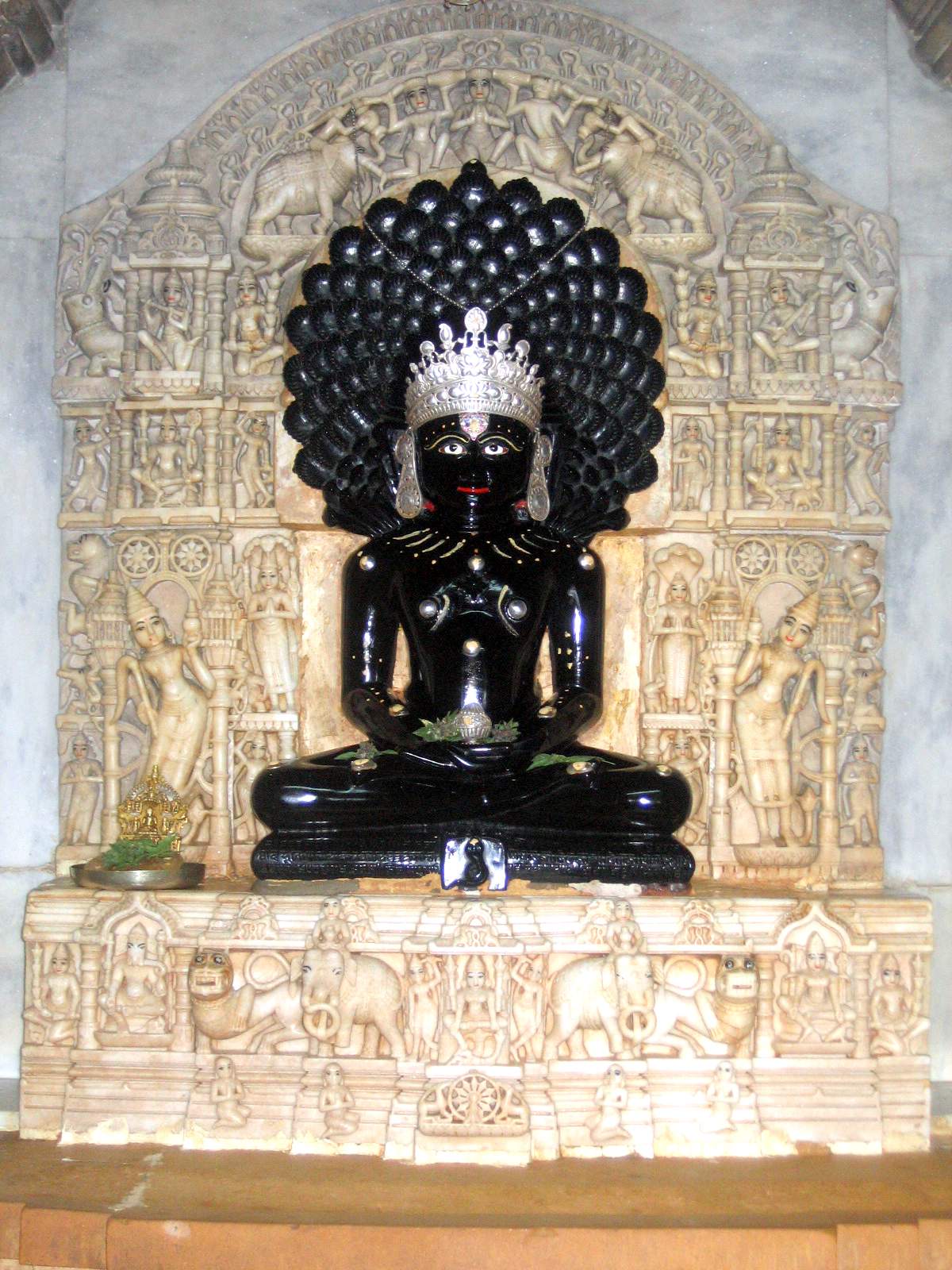
The Uvasagaharam Stotra is composed by Acharya Bhadrabahu (433-357 B.C.), is dedicated to Lord Parshva, the 23rd Tirthankar. Acharya Bhadrabahu had a brother named Varahmihir. Both were in the same kingdom. When a son was born to the king, Varahmihira declared that he would live for a hundred years but Bhadrabahu declared that he would live for only seven days, and that he would be killed by a cat. On the eighth day the prince died because of a door's anklet falling on his head which had a picture of cat drawn on it. Due to this humiliation Varahmihira left the kingdom and died after some time.
According to the story Varahmihira became evil and tortured and terrorized the Jains, especially disciples and followers of Bhadrabahu. Acharya Bhadrabahu then formed a mantric prayer to 23rd Jain Tirthankara Parshvanath called the Upsarga stotra (now known as Uvassagaharam Stotra) and called upon Dharnendra, the divine follower (a "devta") of Parshvanath. As an effect of it, Varahmihira was defeated and Jain society was relieved. That mantric prayer is still famous among the Jains and they chant it with due respect and faith. And that prayer had made Bhadrabahu's name immortal among Jain ascetics.


The Stotra is as below:

UVASAGGA-HARAM PASAM,
PASAM VANDAMI KAMMA-GHANA MUKKAM;
VISAHARA VISA NINNASAM,
MANGALA KALLANA AVASAM. (1)
VISAHARA PHULLINGA MANTAM.
KANTHE DHARE'I JO SAYA MANUO;
TASSA GAHA ROGA MARI,
DUTTHA JARA JANTI UVASAMAM. (2)
CHITTHAU DURE' MANTO,
TUJZHA PANAMO VI BAHUFALO HOI;
NARA-TIRIE'SU VI-JIVA,
PAVANTI NA DUKKHA DOGACHCHAM. (3)
TUHA SAMMATTE LADDHE',
CHINTAMANI KAPPAPAYA VABBHAHIIYE';
PAVANTI AVIGGHE'NAM
JIVA AYARAMARAM THANAM. (4)
IA SANTHUO MAHAYASA !
BHATTIBBHARA NIBBHARENA HIYAE'NA,
TA DE'VA ! DIJJA BOHIM,
BHAVE' BHAVE PASA ! JINACHANDA.

The meaning of the Stotra in English is as below:

I bow to Lord Parshwanath, who is served by the demi god. Parshwa, who is the remover of all afflictions, free from all sorts of Karmas, the destroyer ofthe poison of the poisonous animals, and is the abode of bliss and well-being.

If a man(manuo) who can recite this mantra by-hearted will get healed from all vish(poison) of life.All his problems will be solved by reciting this mantra daily

Aside from that charm, even bowing to you would be highly fruitful (resulting in divine life etc.); all beings would not (thereby) be in an unhappy or a miserable state.

If one gains the truth presented by you, which is superior even to thedesire yielding tree, the soul can gain age-less and immortal state withoutany obstacles. Great graceful Lord, I have adored you this way with devoted heart, therefore Lord Parshwanath, kindly bless me with the true knowledge in every(remaining) birth.

Friday, August 27, 2010

MEDITATION AND KAYOTSARG (abandonment of body)


Meditation (Dhyäna) is the process of concentration of the mind on a single topic preventing it from wandering. We are always every moment in meditation; either virtuous or non-virtuous. This concentration could arise from intense passions like attachment, aversion, hatred, animosity, etc. This is not virtuous meditation. Since non_virtuous meditation is a cause of rebirth, it is worthy of rejection. On the other hand, if it arises from the search for the truth and from absolute detachment towards worldly affairs, it is virtuous meditation.
According to Jainism there are four types of meditation:

  1. Sorrowful Meditation (Arta Dhyana)
  2. Wrathful Meditation (Raudra Dhyana)
  3. Righteous Meditation (Dharma Dhyana)
  4. Pure (spiritual) Meditation (Shukla Dhyana)

    If you observe the state of mind of the people, animal you will realize that most of them are always absorbed in the first two types of meditation (sorrowful and wrathful). Only few of them who are seeking liberation will be found in the righteous and pure meditation.

    1. SORROWFUL MEDITATION (ARTA DHYANA)

    The thought or activity caused by an outburst and intensity of sorrow is sorrowful meditation. In other words to desire for worldly pleasures, desire to get rid of sorrow or to get rid of disease is sorrowful meditation. The result of this type meditation is birth as animal, insect or plant.

    2. WRATHFUL MEDITATION (RAUDRA DHYANA)

    The meditation involving inclement thoughts is called inclement or wrathful meditation. In other words, one becomes happy by performing sinful acts like killing or desire to kill animal, insect, human etc is Wrathful Meditation. The result of this type of meditation is birth in hell.

    Summary of above two types of Dhyäna

    Sorrowful and wrathful meditations hinder spiritual uplift. They obscure the attributes of soul. They cause the natural disposition of self to disappear and initiate corrupt dispositions. Both these meditations are inauspicious and lead to an undesirable destination by accumulating more Karma. They are not related to spiritual advancement in any manner.

    3. RIGHTEOUS MEDITATION (DHARMA DHYANA)

    In this kind of meditation an aspirant meditates on teachings of Tirthankars, chanting mantra, meditates on the 12 Bhavanas (reflections) and asking for forgiveness for our bad deeds. Also the aspirant reflects on the 9 Tattva of the universe in this kind of meditation. The self should think that he/she is simply a light which has no foe or friend. Thereby he/she should leave all desire for beauty, age, strength, wealth etc.

    Types of Righteous Meditation:

    Doctrine oriented (Äjnä_vichaya) righteous meditation:

    It is contemplation about reality as described in the scriptures. Äjnä means whatever an all-knowing omniscient has said about religious truth is correct and true. One should not raise any doubts about them. Instead, one should think that it is possible that because of degrading time, the absence of an omniscient person, low caliber of my intellect, or any such reasons, I cannot comprehend the said religious truth but it is the truth. Omniscient Bhagawän has no reason to tell anything untrue. To think this way is called doctrine oriented righteous meditation (Äjnä Vichaya Dharma Dhyäna).

    Suffering oriented (Apäya_vichaya) righteous meditation:

    To think of the nature of unhappiness and misery as generated by defilements like attachment,, hate, strong desire for worldly pleasure and then to think about how to get rid of the defilements, is called universal suffering oriented righteous meditation (Apäya Vichaya Dharma Dhyäna).

    Karmic fruition oriented (Vipäk_vichaya) righteous meditation:

    To think that whatever pain or misery I suffer at every moment, wherever I move in the cycle of birth and death in worldly life, whatever ignorance I suffer are the results of my own deeds (Karma). I must practice equanimity during the fruition of different kinds of Karma so that new karma are not acquired. I must perform austerities to get rid of the existing Karma. This is karmic fruition oriented righteous meditation (Vipäk Vichaya Dharma Dhyäna).

    Universe oriented (Samsthäna_vichaya) righteous meditation:

    It is contemplation about the nature and structure of the universe. There are three world in the universe. They are the upper world, middle world (consist of billions of galaxies or dweeps) and lower world. These three worlds are filled with living (Jiva) and non_living (Ajiva) elements. The trans-migratory soul has gone through all these three worlds since beginningless time. As a result of the fruits of one’s own past deeds, the soul has been going through the infinite cycle of birth and death. This has happened due to ignorance, false beliefs, and not understanding the truth and reality. To think this way is called universe oriented righteous meditation (Samsthäna Vichaya Dharma Dhyäna).

    4. PUREST AND HIGHEST MEDITATION (SHUKLA DHYANA)

    The concentration achieved by an immaculate mind is the spiritual meditation. Spiritual meditation occurs to very highly progressed spiritual souls. It occurs at the 11th, 12th, 13th and 14th stages of spiritual progress (11, 12, 13, and 14 Gunasthänas). The highly spiritual soul has either suppressed or removed all deluding karma. This meditation is of four types as mentioned below. It consists of four states: Multi aspect (Pruthaktva_vitarka), single aspect (Ekatva_vitarka), subtle activity (Sukshma_kriyä Apratipäti) and absorption in self (Vyuparat_kriyä Anivritti). Vitarka means scriptural text or Sutra. A person who is in 11th and 12th Gunasthäna and is versed in the Purva texts performs the first two Shukla Dhyäna. There are exceptions possible like Mäsatusa and Marudevi, even though not versed in the Purva, can engage in Shukla Dhyäna. Only Kevali (13th or 14th Gunasthäna) can engage in the last two subtypes of Shukla Dhyäna.

    Types of Purest Meditation:

    Multi aspect spiritual meditation (Pruthaktva_vitarka)

    It is performed by an aspirant with scriptural knowledge. Here the aspirant is attempting to attain the spiritual stages of subsidence or destruction of the conduct deluding Karma. The aspirant concentrates upon the three modes - origination, cessations, and continuity- of a particular substance (one of Shad Dravya). This type of meditation involves shifting of attention between the meaning, word and activity of the aspects of the substance. Hence, it is called multi aspect meditation with shifting. This meditation suppresses or eliminates conduct - deluding Karma (Chäritra Mohaniya).

    Single aspect spiritual meditation (Ekatva_vitarka)

    It is contemplation on a single aspect of reality on the basis of scriptural knowledge by an aspirant who is in the delusion free (Kshina_moha) spiritual stage. The aspirant concentrates on one particular form, word, or activity of the aspect of a substance without shifting. Such meditation is the single aspect stage of spiritual meditation. Thismeditation eliminates the four destructive (Ghäti) karma, namely perception obscuring, knowledge obscuring, deluding and obstructing Karma. Thus, it leads to omniscience.

    Subtle activity spiritual meditation (Sukshma_kriyä Apratipäti)

    It is performed by an omniscient who has eliminated the gross activities of body, speech and mind, and has only subtle activities. Here the association of soul with body causes only subtle movements of the space_points of the soul. Hence, it is called the subtle activity stage of spiritual meditation.

    Absorption in self spiritual meditation (Vyuparat_kriyä_anivritti)

    It is performed by an omniscient that eliminates even the slightest activity of the soul in spite of its association with the body. All activities (of the space points of the soul) cease in this meditation. Thus the influx of even the pleasant feeling pertaining (Shätä Vedaniya) Karma is stopped. Finally, all karma are shed and the soul attains salvation. At the end of this meditation, the soul obtains nirvana. The Soul becomes free of all karma, reaches the permanent adobe of Siddha (Siddha Loka) and resides in pure happiness forever.
    According to Jain Scriptures, Shukla Dhyäna is not possible here on this planet at present time. Some misinterpret Shukla Dhyäna as a meditation of bright white color. However, here Shukla does not mean white but pure and it involves the meditation of the self (soul). Maximum time, one can be in meditation is less than 48 minutes.

    Conclusion
    Meditation means the process of concentration of the mind on a single topic. Meditation purifies the body, speech and mind and most importantly the soul. It is of no avail to inflict pain on the body without purifying thoughts. One who stabilizes the mind and concentrates on the self definitely achieves salvation. There are four kinds of meditations - sorrowful, inclement, righteous and spiritual. Sorrowful and inclement meditations are inauspicious and make the soul wander in the transmigratory state with resultant suffering of innumerable births and deaths. Righteous meditation is of an auspicious type. Spiritual meditation occurs at a very high level of spiritual growth of the soul and it ultimately ends in salvation - nirvana of the soul. Now the soul lives in
    permanent happiness in a pure state forever. One should not be misled that physical exercises, Äsana and similar health improving activities, are Dharma Dhyäna. However, good health for good spiritual practice is desirable. Dharma Dhyäna is essentially a spiritual contemplation.

    KAYOTSARG (abandonment of body)


    Kayotsarg means abandonment of body with self-awareness. Body and soul cannot be experienced at the same time. To experience the soul and stop experiencing the body is Kayotsarg. In Kayotsarg the aspirant stops all activities of mind, speech and body. This type of meditation can be done in any posture. It can be done in standing, sitting and sleeping posture. In Kayotsarg, the aspirant feels death-like experience and also imagines, “I am not this body, I am soul” by minimizing the activities of 1) The muscles, 2) Vital flow of energy and 3) Brain activities.

    During Kayotsarg the body is brought into a motionless posture. Starting with the big toe of the right foot up to the highest point of the head and led into unimportance= a death-like state. This meditation like state is one part of the religious activities of followers of Jainism. During Kayotsarg, an aspirant takes vow to remain in a motion-less posture for finite time period like 48 minutes etc.

    Kayotsarg is a very useful meditation technique to realize the real self, the soul.

    Kayotsarg: Purification

    The objective of Kayotsarg is purification of soul. A Jain monk or a householder does retrospection. Kayotsarg forms a part of retrospection. An aspirant accepts Kayotsarg with the following resolution. “I practice Kayotsarg in order to destroy the sinful karma through annulment of past negligence, through penance, purification and freedom from pain”. When the activities of mind, body and speech are stopped in Kayotsarg, the soul starts to get free from much karma accumulated in the past.

    Kayotsarg: Duration

    Bahubali, the son of Lord Rishabhdev stood in Kayotsarg for 12 months without any movement of mind, speech and body. Lord Rishabhdev also remained engrossed in Kayotsarg for 6 months. A question arose as to how long could one practice Kayotsarg? In the scriptures, it is mentioned that the maximum time for one to stay in Kayotsarg is 60,000 years!! It’s not possible for one to do so in the present time period as the life-span of individual has decreased. But one should practice Kayotsarg everyday for at least an hour to destroy previously accumulated karmas.

    -Rahul Zota (Bhuj-Gujarat)

    Thursday, July 29, 2010

    PARASPAROPAGRAHO JIVANAM


    Parasparopagraho Jivanam (Sanskrit: परस्परोपग्रहो जीवानाम् Parasparopagraho Jīvānām) is a Sanskrit sutra or aphorism of the Jain text of Tattvārthasūtra. It is translated as: Souls render service to one another. It is also translated as: All life is bound together by mutual support and interdependence. The etymological root of the phrase Parasparopagraho Jivanam lies in the compound of three Sanskrit words: paraspara (mutual), upagraha (assistance) and jiva (living beings—jivanam is plural of jiva). This sutra has also been accepted as motto of Jainism.


    Motto of Jainism

    The aphorism Parasparopagraho Jīvānām has been accepted as motto of Jainism. It stresses the philosophy of non-violence and ecological harmony on which the Jain ethics and doctrine—especially the doctrines of Ahmisa and Anekantavada—are based. This motto is inscribed in Devanagari script at the base of the symbol of Jainism wihich was adopted by all sects of Jainism while commerating the 2500th anniversary ofnirvana of Mahavira.


    Jain declaration of Nature


    The noted Indian Jurist and Jain leader, L. M. Singhvi in his famous “Jain declaration of Nature” notes:
    Māhavīra proclaimed a profound truth for all times to come when he said: “One who neglects or disregards the existence of earth, air, fire, water and vegetation disregards his own existence which is entwined with them.” Jain cosmology recognizes the fundamental natural phenomenon of symbiosis or mutual dependence, which forms the basis of the modern day science of ecology. It is relevant to recall that the term `ecology’ was coined in the latter half of the nineteenth century from the Greek word oikos, meaning `home’, a place to which one returns. Ecology is the branch of biology which deals with the relations of organisms to their surroundings and to other organisms. The ancient Jain scriptural aphorism Parasparopagraho Jīvānām (All life is bound together by mutual support and interdependence) is refreshingly contemporary in its premise and perspective. It defines the scope of modern ecology while extending it further to a more spacious ‘home’. It means that all aspects of nature belong together and are bound in a physical as well as a metaphysical relationship. Life is viewed as a gift of togetherness, accommodation and assistance in a universe teeming with interdependent constituents.

    Thursday, July 15, 2010

    DIFFERENCE BETWEEN ATTACHMENT AND LOVE

    People always identify attachment as love. In real, attachment is the cause of bondage and both attachment and aversion binds the soul in the mundane world (Samsar). Because of attachment a soul transmigrates through infinite cycle of birth and death. According to Jain cosmology, time has no beginning or end. Hence, the soul is taking births since infinite time and it will remain in the bondage of karma for infinite time unless it gains right vision. To get release from this tie, one has to identify what is love and what is attachment.

    We often see the person shows love to his beloved ones. He says to his wife that he can die for you. And we people call this “love”. Actually, this is attachment. Those who are eager to face truth reflect on the difference between attachment and love. In reflection, they see that attachment always comes with demands or conditions. Imagine, one man is going through a street. He sees a beautiful girl is also going through the street. He doesn’t know her. Now it is natural that he develops attachment toward her. He mentally accepts the girl. Now in the next moment, he sees the same girl talking with her boyfriend. By seeing his heart fills with jealousy and sorrow enters from the next door. Now we can see he himself is the cause of his sorrow. He himself expected a lot and that is the cause of sorrow. He expected for happiness and as a result he got sorrow. The girl even doesn’t know him. In this case she is neutral. There is a beautiful story that tells how attachment can be the cause for one’s spiritual collapse.

    It was the time when Lord Mahavir, the last and the 24th Tirthankar of the present era was giving his last sermon. His last sermon lasted for 48 hours. All the listeners forgot their hunger and thirst and they all were dwelt deep and enjoying the Lord’s magnetic words. In that moment, suddenly the Lord said to Indrabhuti Gautam, his chief disciple, “Gautam! You have to go to Brahmin Dev Sharma to initiate him”. And Indrabhuti Gautam proceeded toward Dev Sharma’s house.

    Indrabhuti Gautam was Lord Mahavir’s chief disciple and he was possessing four types of knowledge. After approaching Dev Sharma’s home he asked,

    “What do you work?”

    Dev Sharma: “Farming!”

    Gautam: “Is your life endures by farming?”

    Dev Sharma: “Yes! We have no problem”

    Gautam: “Have you ever thought about your soul?”

    Dev Sharma: “No! Not yet.”

    Gautam: “See! Lord Mahavir has sent me here to initiate you. Human birth is hard and so rare to achieve. You can purify your soul and attain liberation only in the human form of body. Kindly accept asceticism and come with me, join us. I am sure you will ultimately attain liberation and everlasting happiness.”

    Dev Sharma: “Lord! You are right, but I love my wife so much that I can’t live without her even for a moment!”

    By saying this, Dev Sharma left Gautam unanswered but when he was coming out of his home, his head crashed with the frame of a door and he died on the spot! Indrabhuti Gautam was shocked by seeing Dev Sharma’s immediate death! When he used his knowledge to see his destiny then whatever he saw was this…

    Brahmin Dev Sharma had taken birth in his beloved wife’s hairs as a louse.

    This was the result of attachment. And this is the law of Nature. The nature gives you whatever you want or wish. This law is as natural as gravity, as an apple falls or earth affects on the space-time of geometry. You wish for mundane pleasures, the nature binds you with mundane world. You want mundane pleasure, the nature gives you sorrow. Because sorrow is real face of illusory happiness. You expect Liberation, you will attain liberation. But you are still here because you have never expected liberation. You are attached toward your beloved ones and that is why the nature will keep you closer to them but it is not clear that in which form you will remain close to them, just like Brahmin Dev Sharma remained close to his beloved wife but in a form of a louse!

    Now let’s see what real love is…

    There is a beautiful example of a young monk named Upagupta. It was nighttime during the rainy season, and the path in the forest was covered with a blanket of darkness. Upagupta found his way to a certain tree and sat down to meditate.

    It happened at that time that a famous dancer was going through the same forest to meet her beloved. The darkness was so thick that she could not see where she was going. She was still trying to feel the track underfoot when she bumped into Upagupta.

    Oh!" she exclaimed. "Who is this human being?"

    Just then there was a flash of lightning. In that flash she saw the person she had accidentally come up against.

    "Such a beautiful person is sitting there," she thought. "So calm and serene he is. His lovely face and body look as though they were carved out of pure marble. Oh, if I get this man, this will be heaven on earth!"

    She was proud of her beauty. She was the most famous dancer of her time and men would flock to her feet. She said, "You are so calm. You have such radiance. Please come with me."

    When he did not respond, she shook him and said, "You are meditating on what? See who I am!" Upagupta recognized the dancer. "I know who you are. But this is not the time, though I know that you love me. You go on your way. I will see you one day."

    The dancer thought, "He knows I love him, he says. Then why delay?"

    So she spoke to him again. "What is the reason for postponing? It will be too late. This is the right time."

    He answered, "I know it, but the right time has not come in the right way. I promise you I will meet you. And remember, as you love, I too love. When it is the right time, I will come."

    The dancer thought he was not in his right mind. And she went on.

    Youth is like lightning, like a shadow, like the flow of water, ever-moving, so swift. Ten years passed. The dancer had overused her energy of youth and was now exhausted. She had not taken care of her body and was now suffering from a skin disease. She was trembling with fever and there were blisters on her skin. Nobody would even look at her, and the king drove her from the town. She was compelled to go out to a deserted village and live in a tiny hovel. There she was wasting away, crying and alone.

    The time was right and a man came to see her there. He took her head in his lap. She was shivering with fever as he applied medicine to her sores, mouth, and head.

    "Who are you?" she mumbled.

    "I am Upagupta. Do you remember? I promised you. I love you. I have come to take care of you."

    "Now I don't have anything to offer you," she moaned.

    "No," he told her, "at that time you had something to offer which was transient, something which you yourself could not keep. Now you have something real to offer. I love that which is not going to go. Our relation is for that. It is the relation of soul.

    "In the glamour and ego of the past years, you did not realize the changing nature of all that--of your body, beauty, wealth, and your circle of partying friends. They were all there because there was that need. They were feeding it and now that need is over. My need is not that. Mine is the need of the soul." (Story courtesy: 12 reflections by Chitrabhanu Maharaj).

    The true love is universal. But to understand the true love you have to remain in tune with your soul. The true love is connected by the level of soul. The soul is permanent. It is not connected by the level of bodies, because the body, our relatives etc are transient. Every living being has soul and if you will remain in tune with your soul, you will love every living being of the universe. You will respect every form of life and thus you will never harm any living being. Those who can distinguish what is transient and permanent, he never reacts on hate and love that he receives from the people. He remains neutral in every condition. Like Lord Parshva who remained equal to both Indra and Kamath. Indra praised him and Kamath tortured him. The soul’s upliftment toward emancipation starts from this level of equanimity.

    Tuesday, July 6, 2010

    BIOGRAPHY OF MONK CHANDRUDRACHARYA


    The inspiring story of monk Chand Rudracharya is very popular in the Jain history. Here I have written the story in the biography form.


    My name was Rudracharya. But I was very well known as Chand Rudracharya. Do you know why? Because of my angry nature. My nature was very angry that my disciples called me Chand Rudracharya. Chand means “The Angry One”. I could not control my mind and that was my biggest fault. Whenever I see my disciples are making fun or not concentrating in meditation I immediately lost my mind and shouted at them. I realized that in order to attain omniscience one has to conquer his inner passions like anger, greed, deceit and pride but as I said, it was my biggest minus point to control my anger. I was seeking peace but I wasn’t able to diminish my anger. That’s why one day I decided to stay away from my colleague monks and people. Here I got lucky that an event occurred in which I attained permanent bliss.


    It was evening time and I was meditating outside village. Then some youths who had set out for fun arrived at me. One young man of them was looking recently married by his dress. These youths, out of mischief, wanted to play some joke on me. Pointing at the newly married boy, other youths said in a jocular tone to me, “Oh monk! This young boy wants to renounce the world! Please grant him initiation!” By hearing this, I realized that they were making fun, so I decided to remain silent. The young boy also said, “Oh monk! Please grant me initiation! I don’t want to lead a mundane life!” I became angry and said loudly, “Who wants to take initiation? Come close to me.” His friends pushed that boy toward me. I quickly hold that boy and started pulled out his hair. On seeing this, the other youths ran away; but that youth did not budge an inch. I think his mind was changed and I initiated him on that spot. After becoming a monk, he said, “Oh monk! Soon my relatives would arrive here. It would be better if we left this place before dark.” I said, “Well! You are right, then go and find the way so we can start the journey.”


    The young monk found the suitable way. But it got dark when we started our journey. The path was uneven, strewn with thorns all the way. I got too many jerks that my temper burst out! I said to the young monk, “You fool! Haven’t you seen the way? I told you to find the way but you have chosen the path which is full of bumps and stones. It gives me too much difficulty in walking.” The young monk said, “Oh Monk! It is my fault. Let me carry you on my shoulders. I hope you won’t feel difficulties resting on my shoulders.” He carried me on his shoulders but the path was not plain so I was feeling jerks and my mind once again lost balance. I again shouted on my disciple, “You wretch! Don’t you know how to walk? You can’t walk properly in the way; tell me how would you be able to live a life of a monk? How would you bear hardships in your future?”


    Actually I had lost my mind’s balance, because an angry man doesn’t think longer. I forgot that my disciple was walking through uneven path under pitch darkness. He was also carrying me on his shoulders. His feet were bruised with blisters and stained with blood. But I was also in darkness, the darkness of anger! I started hitting him on his head with the stick I was holding in my hand. I said him, “Whenever I will feel bump, I will hit you with this stick. The young monk was in extremely difficult condition. But instead of getting angry on me he started thinking, “How unlucky I am? I cannot give peace to my head monk. He is old in age and he is facing too much problems because of me. Consequent upon his deep repentance, his thinking was purified and soon he attained omniscience. Now he could walk properly even in pitch darkness. I asked him, "How is that? How can you walk so steady now?" The disciple said, “Oh Monk! It is your blessings!” His voice was very calm and sweet. I couldn’t understand what the reason was! I again asked, “Have you gained some spiritual knowledge?” He again said, “Yes Monk! It is your blessings!” I got freeze! I asked him to confirm, “What type of knowledge you have gained?” He said, “I have gained omniscience!”


    On hearing this, I quickly jumped off his shoulders and fell at his feet. I started confess in my mind…… “Oh! I insulted an omniscient by hitting him on his head. How great he is! He doesn’t know Jain philosophy; he jokingly got initiated this evening and married this morning! What a power of forgiveness! Just by forgiving me he attained omniscience! On the other hand how fool I am? I know all the scriptures, I am head of too many disciples, and however I am too far from reality! Just because of my angry nature, I remained too far from omniscience! When would the moment come when I will also attain omniscience? When would I get rid of my inner passions? On confessing this I burnt karmas and soon my thoughts also vanished. I then reached beyond mind. My joy was increasing and increasing! How was this joy? There are no words to describe this joy; there are no imaginations that can reach at this level! I reached on the level where no words, thoughts, imaginations can reach! I felt that I was climbing some ladder which was ending to emancipation. Suddenly something unfolded inside me and I became omniscient. The whole universe reflected inside me! I knew all the feelings of every form of living beings in the entire universe! I gained complete knowledge of past, present and future.


    I became omniscient is not important. My disciple became omniscient before me is most important and he gifted me omniscience, that is important. He taught me how to overcome your inner passions and how great is the power of forgiveness!


    -Rahul Zota (Bhuj-India)